
Keyword research is the difference between writing content you hope someone wants and writing content you know people are searching for. Get it right and every article you publish has a built-in audience waiting. Get it wrong and you produce beautiful pages that nobody ever finds.
I have watched talented teams pour months into content that never ranked, simply because nobody checked whether the topics had any search demand. This guide walks through the process I use — from finding seed ideas to judging whether a keyword is worth chasing. It pairs naturally with our broader guide to search performance.
What Keyword Research Really Is
At its core, keyword research is demand research. You are not hunting for magic words to sprinkle into your text — you are mapping the questions, problems, and intentions that your audience types into a search box. Each keyword is a tiny window into what someone wants at a specific moment.
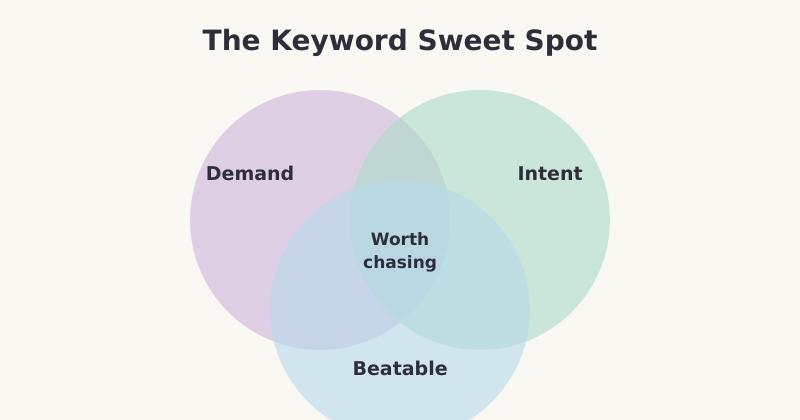
The goal is to find topics that sit in the sweet spot: enough people search for them to be worth your effort, the searchers want what you can offer, and the competition is beatable with the resources you have. Miss any one of those three and the keyword is not worth chasing.
Step 1: Build Your Seed List
Seed keywords are the broad topics your business cares about. They are not your final targets — they are the starting points you will expand. If you sell project management software, your seeds might be “project management,” “task tracking,” and “team collaboration.”
The best seeds come from sources you already have. When I start a project, I pull from four wells before I touch any tool.
- Customer language — read support tickets, sales call notes, and reviews. The exact phrases customers use are gold, because that is what they search
- Your existing pages — Google Search Console shows the queries you already rank for, often including ones you never targeted
- Competitor topics — scan the navigation and blog categories of three or four peers to see what themes they cover
- Sales objections — every “but does it…” question is a keyword someone is searching before they buy
Step 2: Expand Into Real Queries
Now you turn broad seeds into the specific phrases people actually type. A seed like “project management” might expand into hundreds of variations — “project management for small teams,” “free project management templates,” “how to write a project plan.” These long, specific phrases are where most of your opportunity lives.
- Autocomplete — start typing your seed into a search box and note the suggestions. These are real, popular queries
- People Also Ask — the question boxes in search results reveal the follow-up questions searchers have
- Related searches — the suggestions at the bottom of a results page expand your map further
- Keyword tools — a research tool turns one seed into hundreds of variations with demand estimates attached
Pro Tip: Long-tail keywords — those four-word-plus phrases — usually have lower search volume but far higher intent and lower competition. For a new or small site, a portfolio of long-tail wins almost always beats chasing one head term you will never rank for. I built one client’s entire organic strategy on long-tail and grew their traffic past competitors who only targeted the big words.
Step 3: Understand Search Intent
This is the step most people skip, and it is the one that decides whether your page ranks. Search intent is the reason behind a query — what the searcher actually wants to do. Match it and you have a chance. Ignore it and even a perfect article will fail.
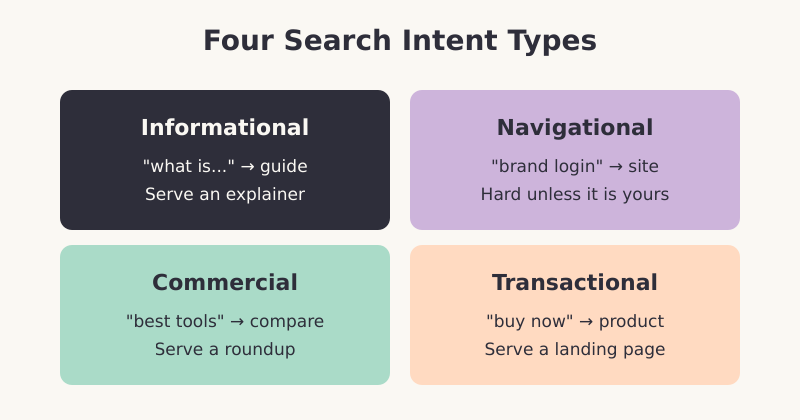
There are four broad intent types, and each demands a different kind of page.
- Informational — the searcher wants to learn (“what is keyword research”). Serve a guide or explainer
- Navigational — they want a specific site or page (“Google Search Console login”). Hard to win unless it is your brand
- Commercial — they are researching before buying (“best keyword research tools”). Serve comparisons and roundups
- Transactional — they are ready to act (“buy SEO software”). Serve a product or landing page
The fastest way to read intent is to look at what already ranks. Search your keyword and study the top results. If they are all listicles, Google has decided this query wants a listicle — publishing a product page instead is fighting the current. Let the results tell you what format to build.
Step 4: Judge the Metrics
Once you have a list of candidate keywords with the right intent, you prioritise. Three numbers guide the decision, and none of them should be read in isolation.
- Search volume — roughly how many searches a keyword gets. Useful for sizing opportunity, but treat the exact number as an estimate, not gospel
- Keyword difficulty — how hard it is to rank, usually based on the strength of pages already ranking. Be honest about your site’s authority
- Business value — how close the searcher is to becoming a customer. A low-volume, high-intent keyword often beats a high-volume vanity term
Early in my career I chased a keyword with 40,000 monthly searches and spent three months barely cracking page three. Meanwhile a colleague targeted a cluster of 200-search, high-intent terms and drove more qualified leads than my “winner” ever would have. Volume is seductive. Relevance pays the bills.
Step 5: Group Keywords Into Topics
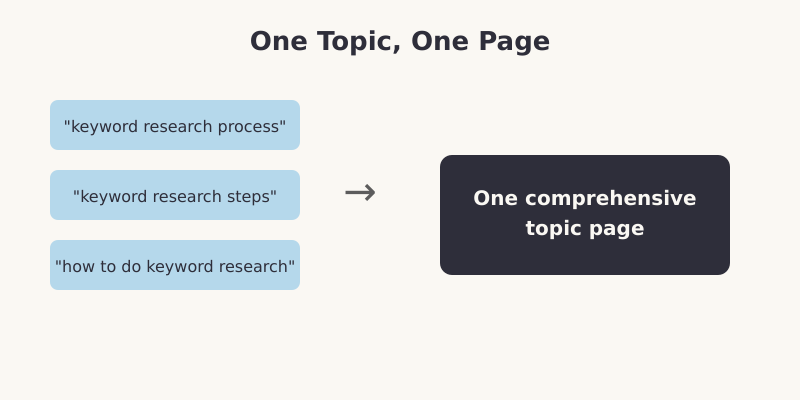
The final step protects you from a common trap: creating ten thin pages that all target near-identical keywords and compete with each other. The fix is to group related keywords into topic clusters, then map one strong page to each cluster — not one page per keyword.
For example, “how to do keyword research,” “keyword research process,” and “keyword research steps” are the same intent dressed in different words. They belong on one comprehensive page, not three. This is the principle of one topic, one page — it concentrates your authority instead of splitting it, and it underpins a healthy site architecture.
Common Mistakes to Avoid
- Chasing volume over intent — a thousand visitors who will never buy are worth less than fifty who will
- Ignoring the results page — if you do not check what already ranks, you are guessing at intent and format
- Keyword stuffing — research informs the topic; it does not give you licence to cram the phrase into every sentence
- One-and-done research — search demand shifts. Revisit your keyword map at least twice a year and after any major industry change
Frequently Asked Questions
How do I do keyword research for free?
You can get a long way with free tools. Google Search Console shows the queries your site already ranks for, autocomplete and People Also Ask reveal real queries, and the related searches at the bottom of a results page expand your list. Free keyword tools add rough volume estimates. Paid tools add depth and speed, but they are not required to start.
What is the difference between short-tail and long-tail keywords?
Short-tail keywords are one or two words with high volume and high competition, like “shoes.” Long-tail keywords are longer, specific phrases with lower volume but clearer intent, like “waterproof trail running shoes for wide feet.” Long-tail terms are easier to rank for and often convert better because the searcher knows exactly what they want.
How many keywords should one page target?
One primary keyword and a cluster of closely related variations that share the same intent. A page about keyword research naturally covers “keyword research process” and “keyword research steps” because they are the same topic. What you should not do is target genuinely different intents on a single page, or split one intent across several thin pages.
How often should I redo keyword research?
Refresh your keyword map at least twice a year, and any time your industry shifts, you launch a new product line, or you notice ranking changes in Search Console. Search behaviour evolves as new terms emerge and old ones fade. A periodic review keeps your content aligned with what people are actually searching for now.
Key Takeaways
Keyword research is demand research, not word hunting. Build seeds from real customer language, expand them into specific queries, read the search intent behind each one, weigh volume against relevance, and group everything into topics so one strong page serves each cluster. Do this consistently and you stop guessing what to write — you start answering questions people are already asking.