If you work in digital marketing, you’ve heard it a thousand times: SEO is dead. And every year, it proves the skeptics wrong. In 2026, search engine optimization isn’t just alive — it’s more complex, more rewarding, and more data-driven than ever before.
I’ve spent over 12 years optimizing websites for search — from small European e-commerce stores to enterprise platforms with millions of pages. What I’ve learned is that the teams who treat SEO as a measurable, analytics-driven discipline consistently outperform those who chase algorithm updates blindly.
This complete SEO guide covers everything you need to build a sustainable search strategy in 2026: technical foundations, on-page optimization, keyword research, Core Web Vitals, link building, and the privacy-first approach that’s reshaping how we track performance. Whether you’re an SEO specialist, a developer, or a site owner trying to grow organic traffic — this is your roadmap.
What Is SEO in 2026?
Search engine optimization (SEO) is the practice of improving your website’s visibility in organic (unpaid) search results. But the definition has evolved significantly since the early days of keyword stuffing and link farms.
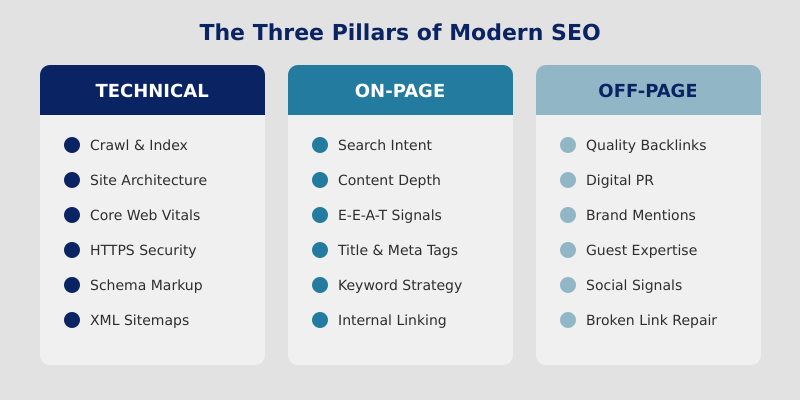
Modern SEO operates across three interconnected layers:
- Technical SEO — ensuring search engines can crawl, index, and render your pages efficiently
- On-page SEO — creating content that matches search intent and demonstrates expertise
- Off-page SEO — building authority through backlinks, brand mentions, and digital PR
What’s different in 2026? Three major shifts have reshaped the landscape. First, AI-generated content has flooded the web, making genuine expertise and Google’s E-E-A-T framework (Experience, Expertise, Authoritativeness, Trustworthiness) more critical than ever. Second, privacy regulations like GDPR and the phase-out of third-party cookies have changed how we measure SEO success. Third, AI search features — Google’s AI Overviews and conversational search — are transforming what it means to “rank.”
Why SEO Still Matters More Than Ever
Despite the rise of social media, paid ads, and AI chatbots, organic search drives over 53% of all website traffic globally. For B2B companies, that number climbs even higher.
Here’s what makes SEO uniquely valuable in 2026:
- Compounding returns — unlike paid ads that stop the moment you cut the budget, a well-optimized page can generate traffic for years
- Trust signal — users trust organic results more than ads. According to Search Engine Land, organic listings receive 70-80% of all clicks on a typical SERP
- Cost efficiency — the average cost-per-click in Google Ads continues to rise. SEO delivers the same traffic without per-click costs
- AI search visibility — content that ranks well organically is the primary source for AI-generated answers
When I work with clients, I frame it simply: paid ads rent attention. SEO builds an asset you own. Both have their place, but the long-term economics of organic search are hard to beat.
Technical SEO: The Foundation You Can’t Skip
Before worrying about keywords or content, your site needs a solid technical foundation. I’ve audited hundreds of websites, and poor technical SEO is the most common reason good content fails to rank.
Here’s your technical SEO checklist for 2026:
Crawlability and Indexing
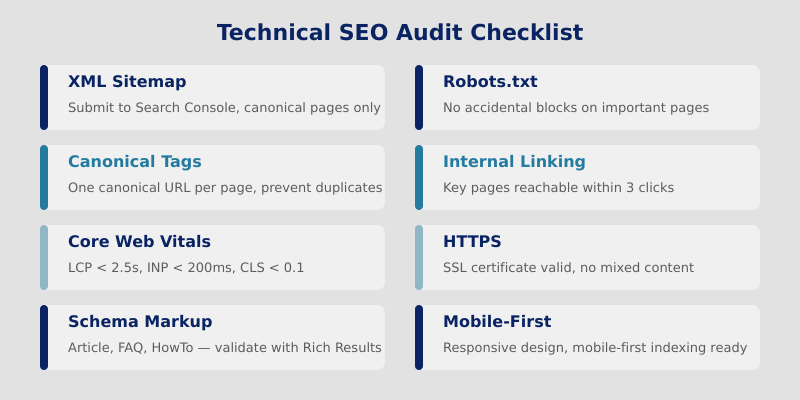
- XML sitemap — submit it through Google Search Console. Include only canonical, indexable pages
- Robots.txt — verify you’re not accidentally blocking important pages. Use the Google robots.txt specification as your reference
- Canonical tags — prevent duplicate content issues by setting a single canonical URL per page
- Internal linking — create a logical site structure where every important page is reachable within 3 clicks from the homepage
Site Architecture
A flat, well-organized architecture helps both users and search engines. I use this rule: if a page takes more than 3 clicks to reach from the homepage, it probably won’t rank well. Google’s documentation on link structure confirms that crawlers follow links to discover pages — if your structure is too deep, important pages get less crawl budget.
HTTPS and Security
HTTPS has been a confirmed ranking signal since 2014. In 2026, there’s no excuse for running HTTP. Beyond rankings, browsers actively warn users about insecure sites — killing your conversion rate before SEO even matters.
Structured Data
Schema markup helps search engines understand your content’s context. Implement Schema.org types like Article, FAQ, HowTo, and Product to qualify for rich snippets. I’ve seen FAQ schema alone increase click-through rates by 15-25% for informational queries.
Use Google’s Rich Results Test to validate your markup before deploying.
On-Page SEO: Content That Actually Ranks
Once your technical foundation is solid, content becomes the differentiator. In 2026, on-page SEO is less about keyword density and more about comprehensively answering search intent.
Search Intent Alignment
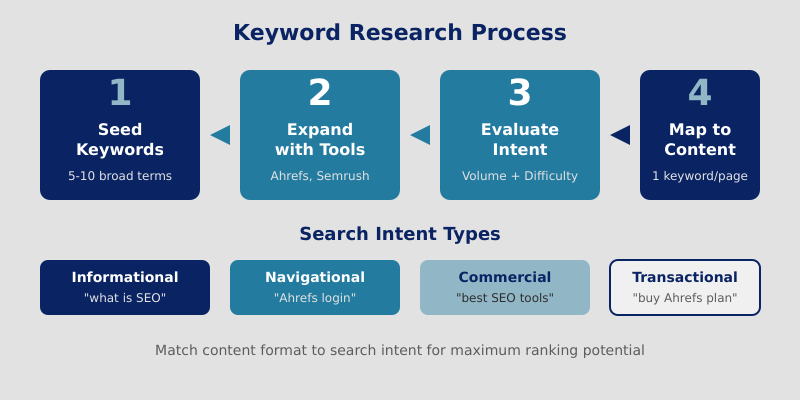
Every search query has an intent: informational, navigational, commercial, or transactional. Your content must match that intent perfectly. A user searching “what is SEO” wants an explanation, not a pricing page. A user searching “SEO agency London” wants services, not a tutorial.
Before writing any page, search the target keyword yourself and analyze the top 5 results. What format do they use? How long are they? What subtopics do they cover? This tells you what Google considers the correct intent match.
Title Tags and Meta Descriptions
- Title tag — include your primary keyword naturally, keep it under 60 characters. This is still one of the strongest on-page signals according to Moz’s analysis
- Meta description — not a direct ranking factor, but it influences click-through rate. Write a compelling 150-160 character summary that makes searchers want to click
- H1 tag — one per page, include the primary keyword. It should match the title tag closely but doesn’t need to be identical
Content Depth and E-E-A-T
Google’s helpful content system rewards pages that demonstrate real experience and expertise. In practice, this means:
- Share specific numbers from your own work (“We increased organic traffic by 180% in 8 months”)
- Show your process, not just the result
- Reference primary sources and link to them
- Update your content when information changes
After Google’s March 2024 core update, I saw several AI-generated content farms lose 60-80% of their traffic overnight. The sites that survived? Those with genuine expertise baked into every paragraph. E-E-A-T isn’t optional anymore — it’s the baseline.
Keyword Research: Finding What People Actually Search
Keyword research is the compass of your SEO strategy. Get it wrong, and you’ll spend months creating content nobody searches for. Get it right, and you’ll build a traffic engine that grows predictably.
The Modern Keyword Research Process
- Seed keywords — start with 5-10 broad terms related to your business. Use your own expertise, customer conversations, and competitor analysis
- Expand with tools — use Ahrefs Keyword Explorer, Semrush Keyword Magic Tool, or Google’s own Keyword Planner to find related terms, questions, and long-tail variations
- Evaluate intent and difficulty — for each keyword, check: monthly search volume, keyword difficulty score, and the type of content currently ranking. Prioritize terms where your expertise gives you a genuine edge
- Map to content — assign each keyword to a specific page. One primary keyword per page, with 2-3 semantically related secondary keywords
Keyword Clustering
Modern SEO groups related keywords into topic clusters. Instead of creating separate pages for “SEO audit checklist,” “technical SEO audit,” and “how to audit website SEO,” you create one comprehensive page that covers the entire topic. Google’s algorithms understand semantic relationships well enough to rank a single thorough page for dozens of related queries.
I typically map keyword clusters using a simple spreadsheet: primary keyword, search volume, difficulty, intent, and assigned URL. This prevents cannibalization — where multiple pages on your site compete for the same query.
Core Web Vitals: Speed as a Ranking Factor
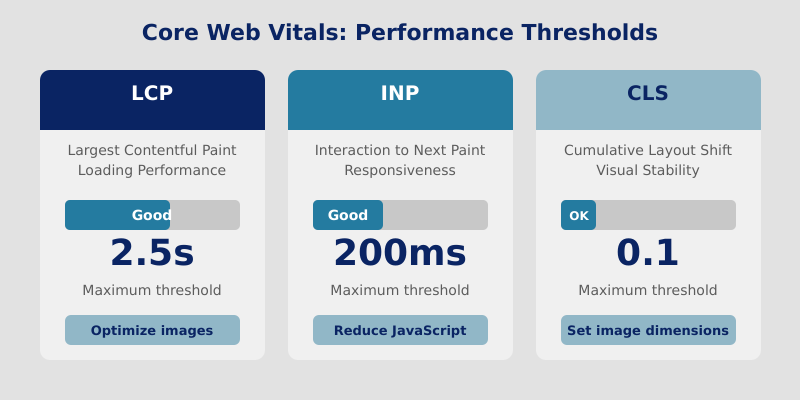
Core Web Vitals (CWV) are Google’s metrics for measuring real-world user experience. They’ve been a confirmed ranking factor since 2021, and their importance has only grown. As of 2026, the three metrics are:
| Metric | What It Measures | Good Threshold |
|---|---|---|
| Largest Contentful Paint (LCP) | Loading performance — how fast the main content appears | Under 2.5 seconds |
| Interaction to Next Paint (INP) | Responsiveness — how fast the page reacts to user input | Under 200 milliseconds |
| Cumulative Layout Shift (CLS) | Visual stability — how much the layout shifts during loading | Under 0.1 |
You can measure your Core Web Vitals using Google PageSpeed Insights, the Chrome UX Report in Search Console, or the web-vitals JavaScript library for real user monitoring.
Quick Wins for Better CWV Scores
- LCP — optimize your largest above-the-fold image. Use modern formats (WebP, AVIF), add
widthandheightattributes, and implementloading="lazy"for below-fold images - INP — minimize JavaScript execution time. Defer non-critical scripts, break up long tasks, and use
requestIdleCallbackfor non-essential work - CLS — always specify image dimensions, avoid inserting content above existing content after load, and use CSS
containfor dynamic elements
In my experience, fixing Core Web Vitals alone doesn’t guarantee ranking improvements. But for pages already competing on content quality, CWV can be the tiebreaker that pushes you from position 5 to position 2. I documented this effect in detail in our web analytics guide, where I explain how to set up performance tracking dashboards.
Link Building: Quality Over Quantity
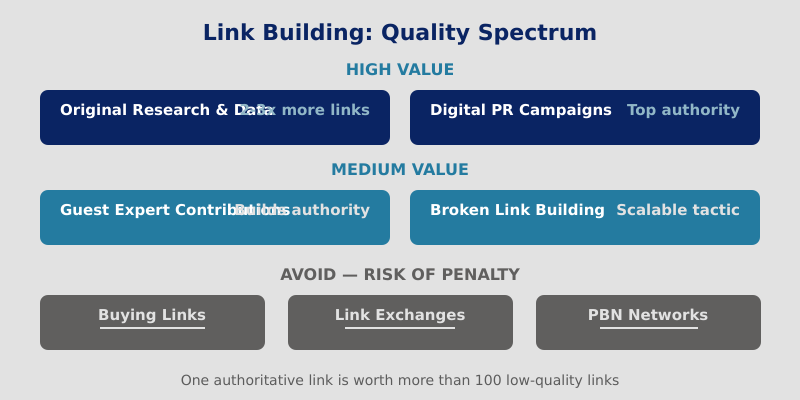
Backlinks remain one of Google’s strongest ranking signals. But the game has changed completely from the days of directory submissions and link exchanges. In 2026, one authoritative link from a respected industry publication is worth more than 100 links from low-quality blogs.
Effective Link Building Strategies
- Original research and data — publish studies, surveys, or analyses with unique data. Journalists and bloggers link to primary sources naturally. Ahrefs’ research shows that data-driven content earns 2-3x more backlinks than opinion pieces
- Digital PR — create newsworthy content and pitch it to relevant publications. This works especially well for industry benchmarks and trend reports
- Guest expertise — contribute expert quotes and analysis to journalists using platforms like HARO, Qwoted, or direct outreach
- Broken link building — find broken links on authoritative sites in your niche, then offer your content as a replacement
What to Avoid
Google’s spam policies are clear about manipulative link practices. Avoid:
- Buying links or participating in link schemes
- Excessive link exchanges (“I’ll link to you if you link to me”)
- Low-quality guest posts on irrelevant sites
- PBNs (private blog networks) — Google has gotten remarkably good at detecting these
Privacy-Aware SEO: The European Perspective
Here’s something most American SEO guides miss entirely: privacy regulations are fundamentally changing how we measure SEO performance. Under GDPR and the ePrivacy Directive, you can’t simply fire Google Analytics on every page load without consent.
This creates a real measurement gap. In my work with European clients, I’ve seen analytics consent rates range from 40% to 75%. That means 25-60% of your organic traffic is invisible in traditional analytics.
Solutions for Privacy-Compliant SEO Tracking
- Server-side analytics — tools like Matomo (self-hosted) or Plausible can run without cookies in a privacy-compliant configuration
- Google Search Console — your best friend for SEO data. It doesn’t require user consent because it measures search performance, not user behavior
- Server log analysis — the oldest analytics method, but still valuable. Parse your nginx or Apache logs to see exactly which pages receive crawl and user traffic
- Consent mode v2 — Google’s solution that sends cookieless pings to model the behavior of non-consenting users. Not perfect, but better than nothing
My recommendation: build your SEO reporting primarily on Search Console data (clicks, impressions, average position) and supplement with privacy-compliant analytics. Don’t rely on Google Analytics alone — you’re likely missing 30-50% of your European traffic.
Measuring SEO Performance with Analytics
SEO without measurement is guesswork. You need clear KPIs and a consistent reporting framework to prove ROI and make data-driven decisions.
Essential SEO KPIs
| KPI | Source | What It Tells You |
|---|---|---|
| Organic sessions | GA4 / Matomo | Overall organic traffic volume |
| Impressions & clicks | Search Console | Visibility and click-through rate in search |
| Average position | Search Console | Ranking trends for target keywords |
| Indexed pages | Search Console | How much of your site Google actually indexes |
| Core Web Vitals scores | PageSpeed Insights / CrUX | Technical performance over time |
| Organic conversions | GA4 / Matomo | Business value from organic traffic |
| Backlink growth | Ahrefs / Semrush | Authority building progress |
I’ve written extensively about setting up tracking dashboards in our web analytics guide. The key principle: connect SEO metrics to business outcomes. Rankings are nice, but revenue from organic traffic is what matters.
Common SEO Mistakes to Avoid
After auditing hundreds of websites, these are the mistakes I see most frequently — and they’re all preventable:
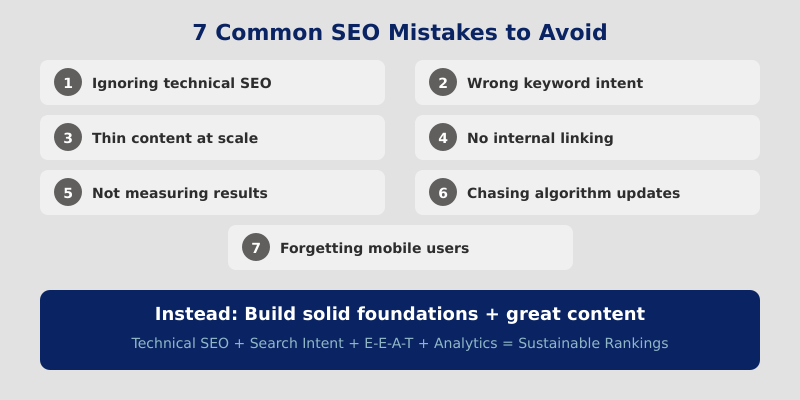
- Ignoring technical SEO — brilliant content on a poorly crawlable site is invisible to Google. Always start with the technical foundation
- Targeting keywords without checking intent — ranking for a keyword whose intent doesn’t match your content leads to high bounce rates and wasted effort
- Creating thin content at scale — publishing 50 mediocre pages won’t beat one comprehensive, authoritative guide. Google’s helpful content system specifically targets this
- Neglecting internal linking — your internal link structure tells Google which pages matter most. A great page with no internal links pointing to it will underperform
- Not measuring results — if you’re not tracking organic traffic, rankings, and conversions, you can’t optimize. Set up Search Console and analytics from day one
- Chasing algorithm updates — reacting to every Google update is exhausting and counterproductive. Focus on creating genuinely useful content and the updates will work in your favor
- Forgetting mobile users — Google uses mobile-first indexing, meaning it primarily uses the mobile version of your site for ranking. If your mobile experience is poor, your rankings will suffer
Frequently Asked Questions
How long does SEO take to show results?
Most websites see measurable improvements within 3-6 months of consistent SEO work. Competitive keywords in established niches can take 6-12 months. Quick wins from technical fixes (crawl errors, speed improvements) can show results within weeks. The timeline depends heavily on your site’s existing authority and the competition level of your target keywords.
Is SEO still worth it in 2026 with AI search?
Absolutely. AI search features like Google’s AI Overviews pull their information primarily from top-ranking organic content. Ranking well in traditional search directly increases your chances of being cited in AI-generated answers. SEO and AI search visibility are complementary, not competing.
What’s the difference between on-page and off-page SEO?
On-page SEO covers everything you control on your website: content quality, title tags, meta descriptions, internal linking, site structure, and page speed. Off-page SEO covers external signals like backlinks, brand mentions, and social signals. Both are essential — think of on-page as making your house beautiful and off-page as getting other people to recommend it.
Do I need to hire an SEO agency or can I do it myself?
Small businesses and individual site owners can absolutely handle SEO themselves using free tools like Google Search Console, Google Analytics, and educational resources from Google Search Central. Consider hiring specialized help for technical audits of large sites, competitive industries, or when you need results faster than your team can deliver.
How often should I update my SEO content?
Review your top-performing pages quarterly and update them whenever information becomes outdated. For time-sensitive topics (like “best tools for 2026”), update at least annually. Pages that start losing rankings or traffic should be refreshed with new data, updated examples, and expanded sections. Consistent updates signal freshness to Google.
Conclusion: Build an SEO Strategy That Lasts
SEO in 2026 rewards expertise, technical excellence, and a commitment to user experience. The days of gaming the algorithm with tricks are long gone — and that’s actually good news. It means the investment you make in quality content and solid technical foundations will compound over time.
Here’s your action plan:
- Audit your technical foundation — fix crawl errors, improve site speed, implement structured data
- Research keywords with intent in mind — don’t just chase volume, match the content format to what searchers actually want
- Create content that demonstrates real expertise — share your experience, back claims with data, and go deeper than the competition
- Build authority through quality links — focus on earning links through original research and genuine expertise
- Measure everything — connect your SEO efforts to analytics dashboards that track real business outcomes
Start with the technical basics, layer on great content, and measure your progress consistently. That’s how you build organic traffic that lasts — not just through the next algorithm update, but for years to come.